

Technology Center
EMMA-ID Electromagnetic Micro-Acoustic Technology
Technical Principle
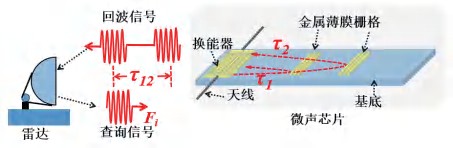
EMMA (Electromagnetic Micro-Acoustic) identification is a radar-based technology: the radar transmits electromagnetic pulses and reads the ID of a micro-acoustic chip. The chip is a MEMS device fabricated on piezoelectric single-crystal (or nano piezoelectric thin-film) material; the ID is carried by Surface Acoustic Wave (SAW) — a technology stack studied for decades and proven in the harshest industrial environments.
At work, the radar emits a query pulse; the micro-acoustic chip converts the electromagnetic pulse into an acoustic wave that travels across the chip substrate and reflects an echo carrying the encoded information. The radar antenna receives and decodes the echo to obtain the chip’s ID or sensing data. The core chip is made of piezoelectric material, which fundamentally solves the industrial limitations of semiconductor RFID — inability to withstand high temperatures and susceptibility to cross-reads.
- ✓Inherently wireless and passive — no power supply, no battery
- ✓Piezoelectric material withstands -200℃ ~ 1100℃
- ✓Lifespan over 40 years
- ✓Reads through obstacles — 1.3m of soil, 0.8m of water
- ✓Reader-RFID-integrated platform: ID plus temperature, pressure, positioning sensing
Six Core Advantages
1
Long Lifespan
Maintenance-free for decades — no periodic tag replacement.
2
Extreme Heat
Up to 600℃~1000℃ continuous operation, far beyond IC-RFID limits.
3
Anti-Collision by Physics
Chip-level structure prevents cross-reading by principle.
4
Strong Penetration
Reads through 1.3m soil / 0.8m water; works in mud, ice and rain.
5
Ultra-Fast Wireless
Inherently passive; fastest wireless ID reading as low as 10µs.
6
Composite Sensing
One tag: ID + temperature + strain + positioning.
Technology Comparison
| Technology | Image Recognition | Conventional IC-RFID | EMMA-ID |
|---|---|---|---|
| Operating principle | Image segmentation + AI number reading | Insulation & scattering design keep chip below 150℃ | Piezoelectric SAW chip works at 350℃; radar reads ID via pulses |
| Max working temp. | Unlimited | 150℃ (250℃ short-term) | 350℃ |
| Read distance | 10m-20m | 5m-20m at room temp; drops sharply when hot | 5m-20m |
| Lifespan | Long (re-painting needed) | 6 months ~ 1 year | Over 5 years, maintenance-free |
| Accuracy | 70-95%; disturbed by glare & molten metal coverage | 80-95%; chips damaged at high temp, severe cross-reading | Up to 100% on rail-served ladles; >98% on truck ladles |
| Maintenance | Periodic number re-painting & lens cleaning | Replace damaged tags regularly | Maintenance-free |
R&D Milestones
From SAW research to 43 steel plants
1
1996
Siemens successfully develops SAW RFID technology for high-speed railway identification
2
2000
Shanghai Jiao Tong University begins SAW technology research
3
2008
Siemens' micro-acoustic team is sold and later dissolved; Austria's CTR company runs the first steel ladle ID trial with the technology
4
2010
Our team receives 3 consecutive NSFC grants, researching micro-acoustic theory, piezoelectric materials and EDA simulation software
5
2016
A Baowu steel plant runs the first SAW RFID trial in its "one-click steelmaking" project
6
2018
First-generation products installed on 39 ladles in the No.1 steelmaking plant of a Baowu plant
7
2019.10
Second-generation products developed and installed on 110 hot metal ladles at Jiangsu Yonggang
8
2019.12
Third-generation products developed; tag housing uses aviation-grade materials to withstand molten steel splash
9
2020.11
System runs stably for 2 years; fully deployed across No.1/2/3 steelmaking and EAF plants at Jiangsu Yonggang Group
10
2021.7
Ladle ID at Baosteel Zhanjiang steelmaking plant adopts this technology
11
2021.10
After 2 years of stable operation, reliability recognized by the owner; EMMA-ID technology officially promoted in the steel industry
12
2025.12
Full EMMA product line successfully deployed at 45+ steel plants and nearly 10 non-ferrous companies nationwide, earning unanimous industry acclaim
13
至今
After 15 years of high-temperature micro-acoustic chip R&D, the team keeps driving the technology into new scenarios and fields, incubating the steel-industry industrial agent "Gangling", striding toward higher, farther and stronger goals